
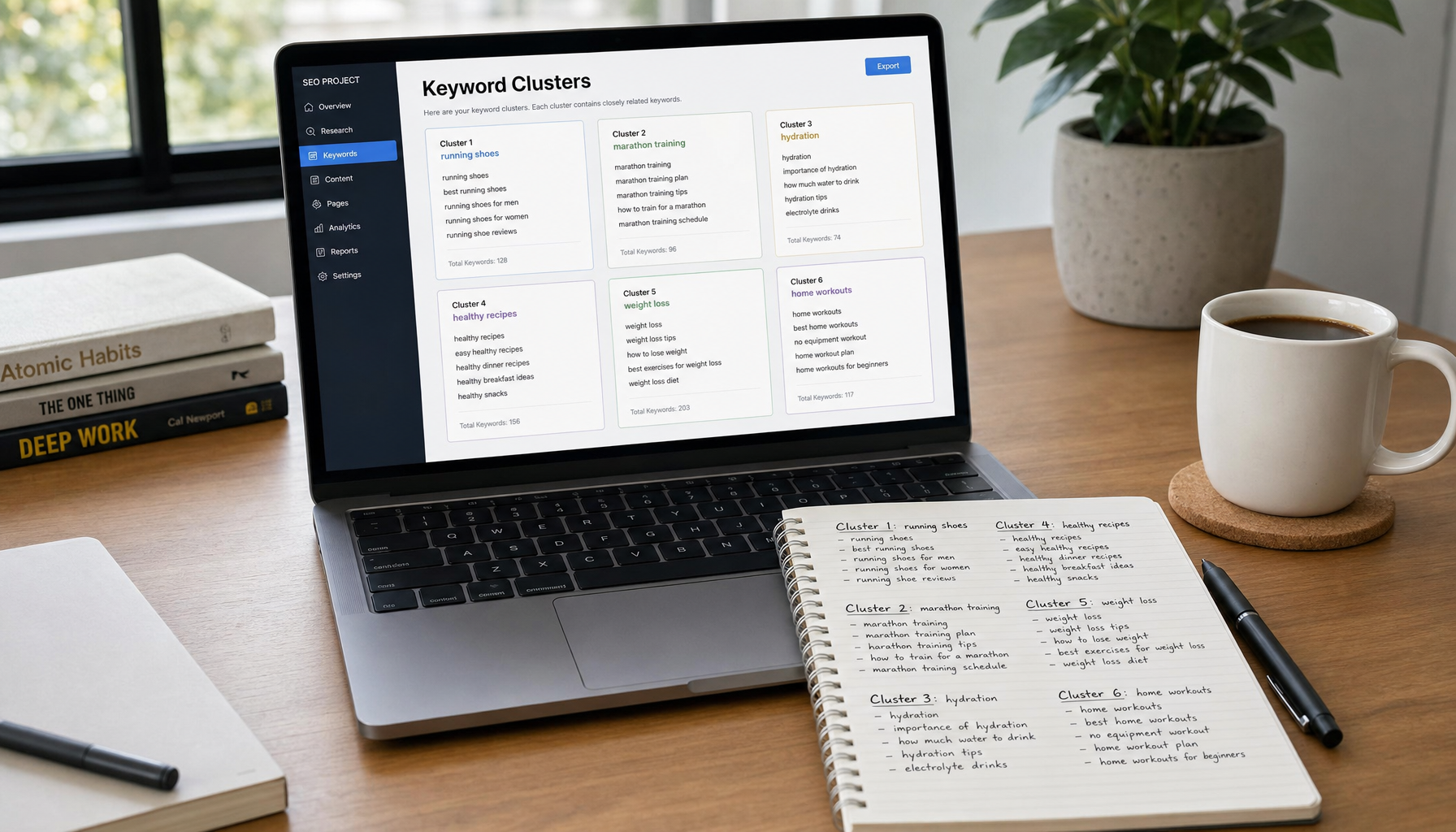
Keyword clustering groups related search terms into topic clusters so you can create content that ranks for multiple keywords at once. Word Spinner free Keyword Clustering Tool turns a raw keyword list into organized groups with search intent labels, suggested page structures, and H1 ideas. No signup needed.
Most SEOs start with too many keywords and not enough pages. You find 200 terms you want to rank for, but each one gets a separate blog post. That is how you end up with 50 thin pages that Google ignores instead of 8 thorough guides that dominate a topic.
Keyword clustering fixes this. You group related queries, build one strong page per cluster, and signal real expertise to search engines. The result: higher rankings, less cannibalization, and content that actually covers what people search for.
What Is Keyword Clustering?
Keyword clustering is the practice of grouping search queries by shared search intent, semantic similarity, or SERP overlap. Instead of treating each keyword as its own target, you treat the cluster as one target and build a single page that satisfies all the queries within it.
A simple example. If you sell running shoes, you might have keywords like "best running shoes for flat feet," "running shoes for arch support," "stability running shoes," and "pronation running shoes." These all share the same intent: someone looking for supportive running footwear. One comprehensive guide titled "Best Running Shoes for Flat Feet and Arch Support" can rank for all four.

Why Keyword Clustering Matters for SEO
Google evaluates topical authority, not individual keyword matches. A page that covers a topic broadly signals more expertise than ten pages that each cover one narrow angle. Clustering is how you shift from the second pattern to the first.
Three specific benefits:
Reduced cannibalization. When you have 15 pages targeting 15 similar keywords, they compete against each other. Google picks one to rank and ignores the rest. Clustering merges those 15 targets into 3 pages, each distinct enough to earn its place.
Stronger internal linking. Cluster-based pages naturally link to each other through pillar-and-cluster structures. These internal links pass authority and help search engines understand your site architecture.
Higher CTR from featured snippets. Comprehensive cluster pages are more likely to earn featured snippets and People Also Ask placements because they answer more related questions within one piece of content.
How the Word Spinner Keyword Clustering Tool Works
The free tool at Word Spinner Keyword Clustering Tool uses semantic analysis to group your keywords. Here is the workflow.
Step 1: Paste your keyword list. Copy and paste up to 200 keywords. The tool accepts one keyword per line or comma-separated values. No CSV upload needed, no signup required.
Step 2: Review your clusters. The tool groups keywords by semantic intent. Each cluster shows the shared topic, estimated search intent (informational, commercial, navigational, transactional), and the keywords that belong to it.
Step 3: Get page recommendations. For each cluster, the tool suggests a page title, H1, meta description, and content structure. These are starting points you can edit before writing.
Step 4: Export or copy. Copy individual clusters or export the full plan. The tool runs entirely in your browser and your keywords never leave your machine.

Keyword Clustering Methods Compared
There are three main approaches to clustering keywords. Each works for different use cases.
| Method | How It Works | Best For | Tools |
|---|---|---|---|
| Manual clustering | Sort keywords into groups by hand using a spreadsheet | Small keyword sets under 50 terms | Google Sheets, Excel |
| SERP-based clustering | Groups keywords that share overlapping search results | Medium to large sets where SERP overlap signals shared intent | Keyword Clustering Tool, Semrush |
| Semantic/ AI clustering | Uses NLP to group semantically related terms | Large keyword lists with diverse phrasing | Word Spinner Keyword Clustering Tool |
How to Build a Keyword Cluster Strategy
Building an effective clustering strategy takes more than running keywords through a tool. Here is the process that works.
1. Gather your seed keywords. Start with your core topics and expand using keyword research. Your free keyword difficulty checker can help you prioritize terms by competition level.
2. Run the clustering tool. Paste your full list into the Word Spinner Keyword Clustering Tool. Review the groups and adjust any clusters that feel off.
3. Map clusters to content. Each cluster becomes one page. For clusters with high search volume and many keywords, consider a pillar page. Smaller clusters work as blog posts or subpages.
4. Build internal links. Link from each cluster page to your main pillar content and between related clusters. This is where the free internal link checker helps track your connections.
5. Write and optimize. Write one comprehensive page per cluster. Cover every keyword in the group naturally. Use the suggested H1 and meta description from the clustering tool as your starting point.
Keyword Clustering Examples
Here are three real examples of clustering in action.
Example 1: Local SEO. Keywords: "plumber Austin," "emergency plumber Austin," "plumber near me Austin," "water heater repair Austin," "drain cleaning Austin." Cluster: One "Plumber Austin" service page with dedicated sections for each service type. Result: The page ranks for all five terms instead of competing against five separate pages.
Example 2: Ecommerce. Keywords: "organic coffee beans," "fair trade coffee online," "single origin coffee," "best coffee for French press," "ethically sourced coffee." Cluster: One "Organic Coffee Beans" category page with filters and buying guide content. Result: Higher category page authority drives more individual product rankings.
Example 3: SaaS. Keywords: "project management software," "team task manager," "online project planner," "agile project tools," "collaboration software for teams." Cluster: One "Project Management Software" comparison page with feature breakdowns. Result: Captures both commercial and informational search intents on one page.
Frequently Asked Questions
How many keywords should I put in one cluster?
Most clusters work well with 3 to 10 keywords. If a cluster has more than 15 terms, split it into subtopics or consider a pillar page structure. The right size depends on how closely related the search intents are.
Can I use keyword clustering for PPC campaigns?
Yes. Clustering keywords by intent helps structure ad groups so each ad targets a tightly related set of terms. This improves Quality Score and lowers cost per click. Most PPC platforms recommend grouping keywords by shared intent inside each ad group.
Whats the difference between keyword clustering and topic clustering?
Keyword clustering groups individual search queries. Topic clustering organizes entire content themes. A topic cluster might include multiple keyword clusters. For example, a "Content Marketing" topic cluster could contain keyword clusters for "blog writing," "email marketing," and "SEO strategy."
Is the Word Spinner Keyword Clustering Tool free?
Yes, the tool is completely free to use. You can paste up to 200 keywords per session, view semantic clusters, get page recommendations, and export your results. No account creation or signup required.
How often should I update my keyword clusters?
Review your clusters every quarter or whenever you add a major content section. Search trends shift, new keywords emerge, and old ones lose volume. A quarterly refresh keeps your content strategy aligned with actual search demand.