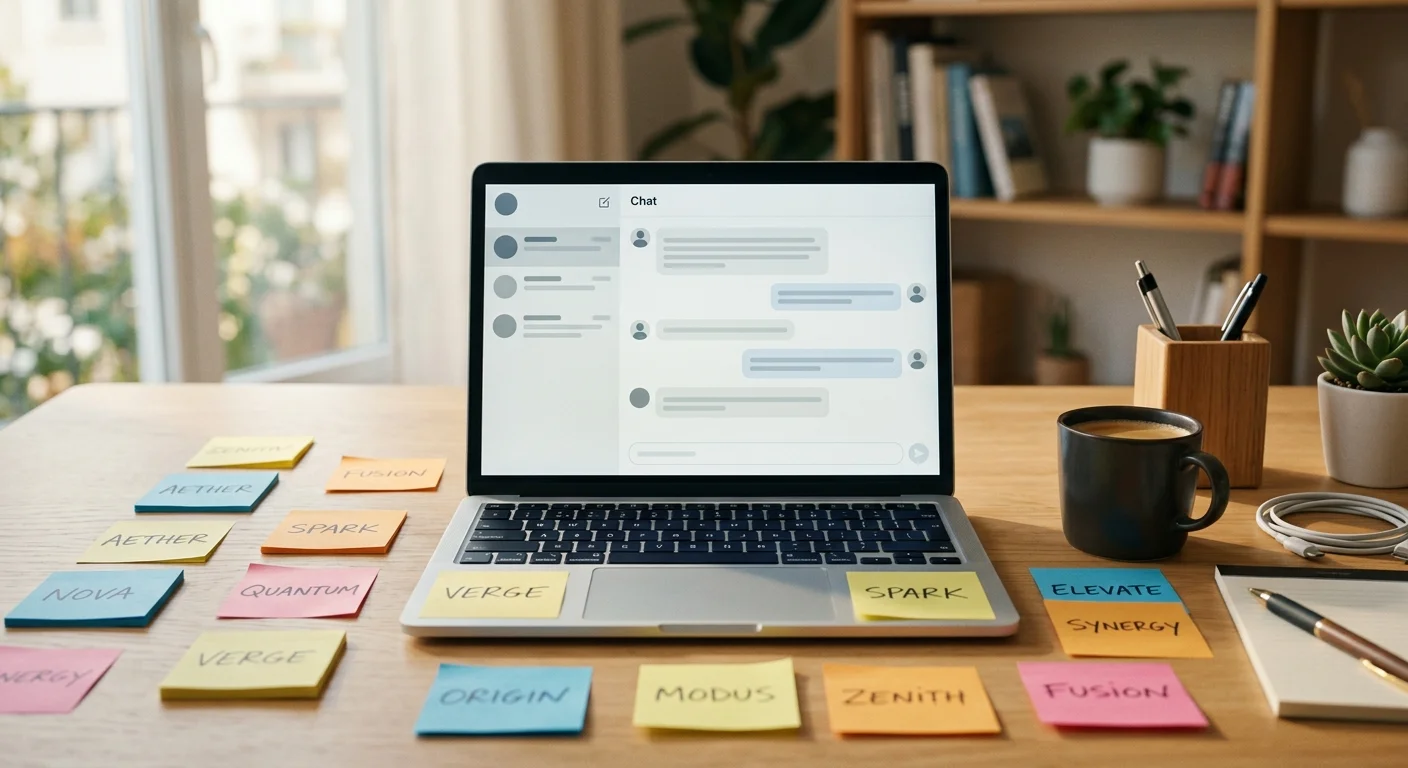
An AI chatbot name generator is a free tool that creates unique, brandable names for your chatbot or AI assistant. Tell it your industry, tone, and target audience, and it generates 10 name ideas with rationale and domain availability checks in seconds.
Picking the right name for a chatbot sounds easy until you actually do it. You want something memorable but not gimmicky, professional but not boring, distinct but not weird. Most teams burn hours in Slack threads and still end up with something they are not sure about.
That is exactly why we built the free AI chatbot name generator at Word Spinner Tools. It takes the guesswork out of naming so you can focus on actually building and deploying your bot.
What Is an AI Chatbot Name Generator?
An AI chatbot name generator is a free online tool that uses artificial intelligence to suggest creative, relevant names for chatbots, virtual assistants, and AI agents. You provide a few inputs -- your industry, the bot's personality, what it does -- and the tool returns a curated list of naming options.
Unlike generic business name generators, a chatbot-specific naming tool understands the conventions that make bot names work: short, pronounceable, personality-driven, and distinct from your brand name. Research from Nielsen Norman Group shows that users form lasting impressions of chatbots within seconds, and the name is the single biggest factor in that first impression.

Why Your Chatbot's Name Actually Matters
A chatbot's name does more than sit in a corner of the chat window. It sets the tone for every interaction your users have with your AI.
| Impact area | What the data shows |
|---|---|
| First impressions | Users decide whether to trust a chatbot within 5-7 seconds. The name is the first thing they notice. |
| Engagement rates | Chatbots with human-like names see 18-28% higher engagement than those with generic labels like "Support Bot." |
| Brand recall | A distinctive bot name makes your brand more memorable, even when users forget your company name. |
| Escalation behavior | Users are more patient with a named bot before requesting a human -- they treat it like a colleague, not a machine. |
The difference between "ChatBot v2" and "Nova" is not cosmetic. It is the difference between users who bounce and users who convert.
How Our Free AI Chatbot Name Generator Works
You do not need a naming agency or a 3-hour workshop. Here is the full process, start to finish:
Step 1: Enter your industry. Tell the tool what space you are in -- SaaS, healthcare, ecommerce, fintech, education, or anything else. This narrows the AI's suggestions to names that fit your context.
Step 2: Pick a personality tone. Choose from Professional, Friendly, Witty, or Technical. The tone shapes whether you get names like "Atlas" (professional) or "Pixel" (playful).
Step 3: Add optional keywords. Want the name to hint at speed? Type "fast." Customer service? Type "helpful." These keywords act as creative constraints that make suggestions more relevant.
Step 4: Get 10 name ideas. The tool generates 10 unique names, each with a short rationale explaining why the name fits your inputs. No generic filler -- every suggestion is specific to your configuration.
Step 5: Check domain availability. For each name, the tool shows whether matching .com and .ai domains are available. Useful if you plan to give your chatbot its own landing page.
Good vs Great Chatbot Names: Examples That Show the Difference
Most teams land on a name and move on. But the gap between "fine" and "memorable" is wider than you think. As HubSpot's guide to chatbot naming points out, the best bot names do three things: they reflect the brand, hint at the bot's purpose, and are easy to remember.
| Industry | Generic name | Better name | Why it works |
|---|---|---|---|
| Healthcare | HealthBot | Florence | Evokes care and history (Nightingale) without being clinical |
| Fintech | FinanceHelper | Ledger | Single word, industry-native, sounds competent and precise |
| Ecommerce | ShopBot | Scout | Implies the bot finds things for you -- active, helpful, short |
| SaaS | SaaSBuddy | Nova | Modern, gender-neutral, tech-forward without sounding artificial |
| Education | EduBot | Sage | Suggests wisdom, approachable, one syllable -- easy to remember |
The pattern is consistent: good names are specific to their context, easy to say, and carry a hint of personality. Bad names describe what the thing is instead of what it feels like to use it.

5 Chatbot Naming Tips From Real Deployments
After helping thousands of users name their chatbots and AI assistants, here are the patterns that consistently produce strong results:
1. Keep it under 10 characters. Short names are easier to type, remember, and fit into chat interfaces. Slack bots like "Polly" and "Donut" prove that short names punch above their weight. Our AI chatbot name generator defaults to short suggestions for exactly this reason.
2. Avoid your brand name in the bot's name. Calling your chatbot "BrandNameBot" feels lazy and makes your brand look like it is trying too hard. Give the bot its own identity. Users enjoy talking to a named assistant more than a walking trademark.
3. Match the name to the task. A financial advisor bot named "Chipper" sends the wrong signal. A customer support bot named "Athena" (wisdom) sends the right one. The name should telegraph what the bot is good at.
4. Test pronunciation across your audience. If your users span multiple languages or regions, say the name out loud. If it trips people up, scrap it. A name that requires explanation is a name that fails.
5. Check for existing bots with the same name. Before you commit, search "[name] chatbot" or "[name] AI" on Google. If another chatbot is already using the name -- especially in a related industry -- pick a different one.
If you are naming more than just a chatbot -- say, an entire SaaS product or AI brand -- our free AI SaaS brand name generator follows a similar workflow but optimized for company-level naming.
AI Chatbot Name Generator vs Doing It Manually
According to Intercom's research on chatbot design, the teams that invest time in naming see measurably better outcomes than those that rush to deploy. Here is how the two approaches compare:
| Factor | AI name generator | Manual brainstorming |
|---|---|---|
| Time to 10 ideas | Under 10 seconds | 30-90 minutes, often spread across multiple sessions |
| Variety of styles | High: pulls from multiple naming patterns automatically | Low: teams tend to cluster around the same few ideas |
| Domain availability | Checked instantly for each suggestion | Must be checked manually, one by one |
| Rationale per name | Yes: every suggestion comes with an explanation | Rarely documented: names get picked on gut feel |
| Bias | None: does not favor the CEO's suggestion | High: loudest voice or highest-paid person tends to win |
The generator is not a replacement for human judgment -- you still make the final call. But it compresses the ugly, repetitive part of naming into seconds so your team can spend time on what matters: testing the name with real users.
Common Questions About AI Chatbot Names
Should my chatbot have a human name or a descriptive one?
Human names (like "Ada," "Max," "Sage") consistently outperform descriptive names (like "SupportBot," "FAQHelper") in engagement metrics. Users anthropomorphize chatbots -- they respond to names that feel like people.
Can I change my chatbot's name after launch?
Yes, but it is better not to. Users build familiarity with a chatbot's name over time. Changing it mid-stream creates confusion and can hurt engagement. The free AI chatbot name generator helps you avoid the rename problem by getting it right the first time.
How many name options should I generate before deciding?
Generate at least 30 names across 3 rounds of the tool, with slight variations in tone and keywords each time. From those 30, shortlist 5. Test those 5 with 3-5 colleagues or target users. The winning name usually becomes obvious through this process.
Does the chatbot name affect SEO?
Indirectly, yes. If your chatbot has a dedicated landing page or knowledge base, the name becomes a branded search term. A unique name is easier to rank for than a generic one.
What if I need to name multiple chatbots for different purposes?
Use the tool once per chatbot, varying the purpose and tone each time. Keep a consistent naming theme across your bot family so users know they are interacting with the same brand's AI, just specialized for different tasks. For broader naming needs, our AI SaaS brand name generator handles company and product-level naming.
What to Do After You Pick a Name
Naming is step one. After you have a name you love, here is what comes next:
Set up your chatbot. If you are building on a platform like Intercom, Zendesk, or a custom stack, configure the bot's display name, avatar, and welcome message. The name should appear consistently across all touchpoints -- chat widget, email notifications, and help center.
Write a short backstory. You do not need lore. But knowing your chatbot "works in customer success" or "is an AI research assistant" helps your team write consistent responses and helps users understand what to expect from the bot.
Measure how users react. Watch your first 100 interactions. Do users greet the bot by name? Do they treat it casually or formally? This data tells you whether the name is working or if it needs adjusting.
And if you need help crafting the actual responses your chatbot sends, our free AI reply generator handles that part of the workflow -- from welcome messages to escalation scripts.